
Free VIN Decoder
Official NHTSA Vehicle Lookup
Instantly identify vehicle specifications with 100% accuracy using the APAI free VIN check, powered by official NHTSA data.
Precision Starts with the Right Vehicle Data
In the auto glass industry, ordering the wrong part costs time, money, and customer trust. Two vehicles of the same year, make, and model can leave the factory with three completely different windshields depending on their trim level and option packages. The APAI VIN decoder eliminates that guesswork by pulling confirmed vehicle specification data directly from the NHTSA vPIC database.
Auto glass technicians and shop CSRs use the VIN to confirm the exact body class, trim designation, and factory-installed glass features before placing any order. Whether you are quoting a windshield replacement, identifying a rain sensor, or determining whether ADAS recalibration is required, the VIN is the only reliable starting point.
Official NHTSA accuracy
The decoder pulls live data directly from the NHTSA vPIC API, the same database used by manufacturers and state DMVs across the United States.
Built for technicians in the field
The tool is mobile-first and returns results in under three seconds. Use it on-site, on the road, or at the counter while a customer is on the phone.
Glass-ready data output
While general VIN decoders return engine and transmission data, APAI returns the vehicle data that matters for glass: body class, trim, and the specifications that feed our SmartVIN part matching engine.
What Each VIN Position Tells Your Auto Glass Shop
Every vehicle sold in the United States carries a 17 character Vehicle Identification Number. Each character or group of characters encodes a specific piece of vehicle data. For auto glass professionals, positions 1 through 10 are the most critical because they determine the exact windshield specification, glass type, and any advanced driver assistance systems installed at the factory.
| Positions | Name | What it encodes | Relevance to glass shops |
|---|---|---|---|
| 1 to 3 | World Manufacturer Identifier (WMI) | Country of origin and manufacturer | Confirms OEM. Some manufacturers use proprietary glass coatings or mounting specs. |
| 4 to 8 | Vehicle Descriptor Section (VDS) | Body style, restraint system, engine type, trim | Critical. Determines windshield curvature, sensor cutouts, frit pattern, and glass type. |
| 9 | Check digit | Mathematical validation of the full VIN | Use to catch invalid or transposed VINs before ordering parts. |
| 10 | Model year | Single character encoding the model year (A to Y, 1 to 9) | A 2024 and 2025 model may use different windshield part numbers. Always confirm. |
| 11 | Plant code | The assembly plant where the vehicle was built | Regional builds can differ in glass specs even for the same model year. |
| 12 to 17 | Serial number | Unique vehicle sequence number | Combined with positions 1 to 11, makes every VIN globally unique. |
World Manufacturer Identifier (WMI)
What it encodes:Country of origin and manufacturer
Relevance to glass shopsConfirms OEM. Some manufacturers use proprietary glass coatings or mounting specs.
Vehicle Descriptor Section (VDS)
What it encodes:Body style, restraint system, engine type, trim
Relevance to glass shopsCritical. Determines windshield curvature, sensor cutouts, frit pattern, and glass type.
Check digit
What it encodes:Mathematical validation of the full VIN
Relevance to glass shopsUse to catch invalid or transposed VINs before ordering parts.
Model year
What it encodes:Single character encoding the model year (A to Y, 1 to 9)
Relevance to glass shopsA 2024 and 2025 model may use different windshield part numbers. Always confirm.
Plant code
What it encodes:The assembly plant where the vehicle was built
Relevance to glass shopsRegional builds can differ in glass specs even for the same model year.
Serial number
What it encodes:Unique vehicle sequence number
Relevance to glass shopsCombined with positions 1 to 11, makes every VIN globally unique.
Positions 4 through 8 are where the windshield specification lives. Within a single trim level, the manufacturer may have offered multiple glass packages, such as acoustic laminated glass, solar tinted glass, or infrared reflective glass. A VIN decode confirms which package the vehicle left the factory with, so your shop orders the correct part the first time.
Glass Features Your Shop Needs to Know Before Ordering
A standard VIN decode returns year, make, and model. But for auto glass professionals, that is only the starting point. Modern vehicles leave the factory with a wide range of glass embedded features that determine which part number to order and whether ADAS recalibration is required after installation. The following features are identifiable through a combination of VIN data and factory option package records.
Rain sensors
Factory installed rain sensors mount to the inner surface of the windshield. Ordering a windshield without the correct sensor port will require cutting or returns. VIN and trim data confirm whether the vehicle left the factory with this feature.
Heated wiper park zone
Some windshields include a heated element at the base that prevents wiper blades from freezing in place. This feature requires a specific windshield part number and wiring harness compatibility. Misidentification is a common source of returns in northern US markets.
Forward-facing ADAS cameras
Lane departure, automatic emergency braking, and adaptive cruise control systems use a camera mounted behind the windshield. After any windshield replacement, this camera must be recalibrated. VIN data confirms whether the feature is installed so technicians arrive on-site prepared.
Heads-up display (HUD) projection zone
Vehicles with HUD systems require a windshield with a specific laminate that prevents double-imaging of the projected display. Installing a standard windshield on a HUD equipped vehicle produces an unusable display and a callback. Confirming HUD equipment before ordering prevents this entirely.
Acoustic or solar-tinted glass packages
Luxury and mid-tier trims often include acoustic laminated glass that reduces cabin noise, or solar-tinted glass that blocks infrared heat. These part numbers differ from standard glass and carry different pricing. VIN and trim data confirm which package applies.
From VIN to NAGS Part Number: How Auto Glass Shops Use the Decoder
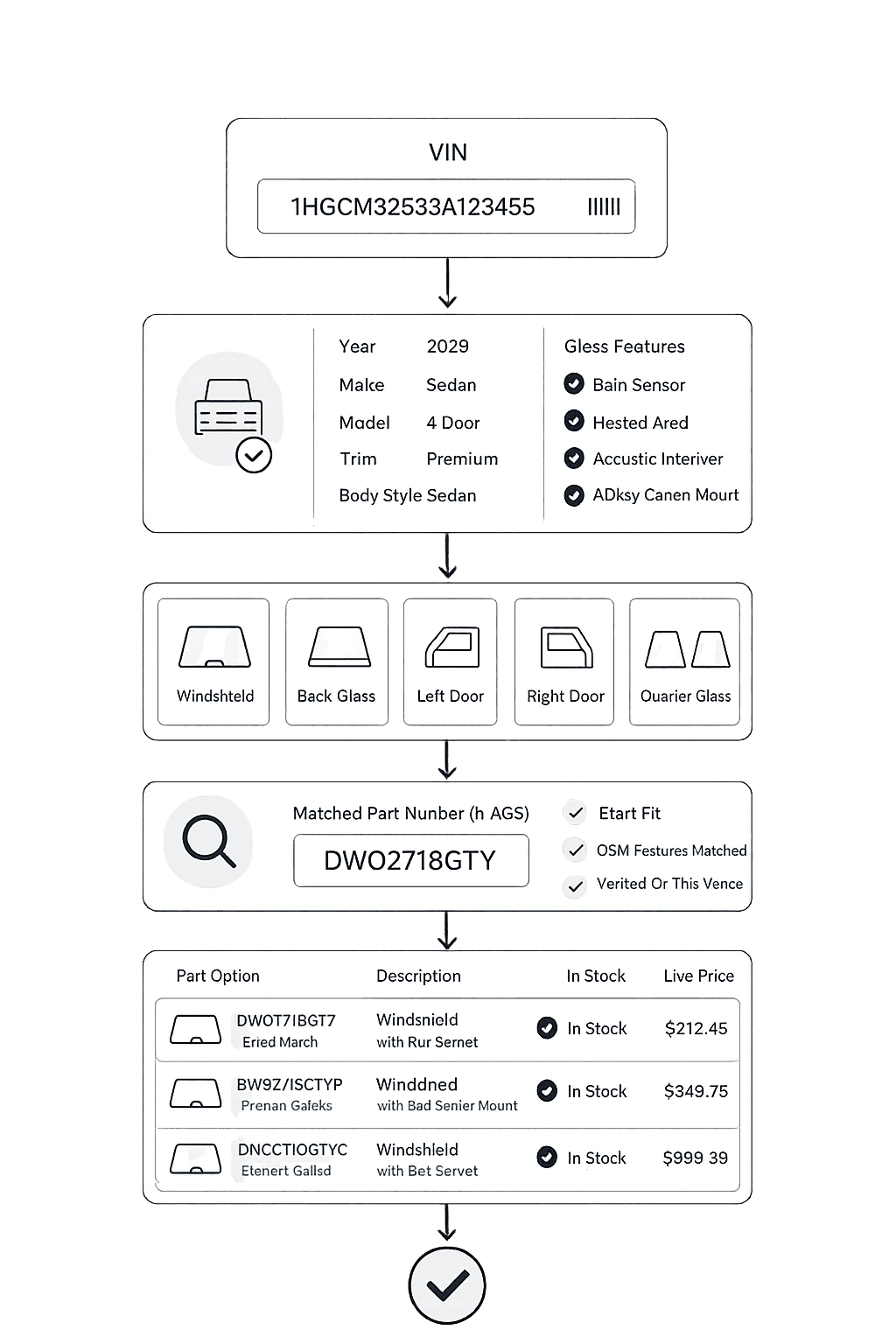
NAGS (National Auto Glass Specifications) part numbers are the industry standard reference for sourcing auto glass in the United States. Every distributor, from Pilkington to PGW, uses NAGS numbers to catalog and price their inventory. Without the correct NAGS number, shops risk ordering the wrong glass, waiting for returns, and delaying jobs. The bridge between a VIN and the correct NAGS number is vehicle specification data. The VIN confirms the year, make, model, body style, and trim. That combination maps to one or more NAGS part numbers depending on the glass features installed at the factory. A shop that skips the VIN step and quotes from memory or from year-make-model alone risks ending up with a part that fits the opening but not the vehicle. The full APAI SmartVIN platform automates this entire lookup. After decoding a VIN, SmartVIN cross-references the vehicle specification against the NAGS database and returns the exact part number for the job, along with live distributor pricing from your connected suppliers. What used to take three separate lookups takes under ten seconds.
SmartVIN: From VIN Decode to Job Ready in Seconds
A basic NHTSA VIN lookup tells you the engine displacement and the assembly plant. Auto glass professionals need more. SmartVIN is the APAI technology layer that takes raw NHTSA data and turns it into actionable job information: the exact NAGS part number, the ADAS systems that need calibration, and live pricing from your distributor network.
Identify car parts by VIN: NAGS part number mapping
SmartVIN automatically cross references the decoded vehicle data against the full NAGS parts database. Enter a VIN and the platform returns the correct windshield part number, not a shortlist of possibilities. This eliminates the manual lookup step that slows down quoting and causes ordering errors.
ADAS identification and calibration flags
SmartVIN identifies every ADAS system on the vehicle and flags which systems require static or dynamic recalibration after glass replacement. Your technician arrives at every job knowing exactly what equipment to bring and what the calibration scope includes. No surprises, no callbacks.
Live distributor pricing integration
From a decoded VIN, SmartVIN connects directly to your distributor network and returns live part availability and pricing from suppliers including Pilkington, PGW, and others. Quote the customer accurately while they are still on the phone.
VIN Model Year Code Reference (Position 10)
The 10th character of every VIN encodes the model year. Use the table below to confirm the model year before looking up a windshield part number. A one-year difference in model year can mean a completely different glass specification.
Frequently Asked Questions
Is this a free VIN check?
What information is included in the NHTSA VIN lookup?
Can I find a NAGS part number using this VIN decoder?
Does this windshield VIN search work for all US vehicles?
How do I get more than just the basic specs?
What other features does APAI provide?
Learn More About VIN Decoding & Auto Glass Accuracy
Explore in-depth guides on vehicle identification numbers, NAGS part mapping, and how top auto glass shops eliminate ordering mistakes.

Anatomy of a VIN: Understanding Vehicle Identification Numbers
Learn how the 17-character VIN code breaks down into WMI, VDS, and VIS to reveal vehicle specs, trim levels, and factory glass options.
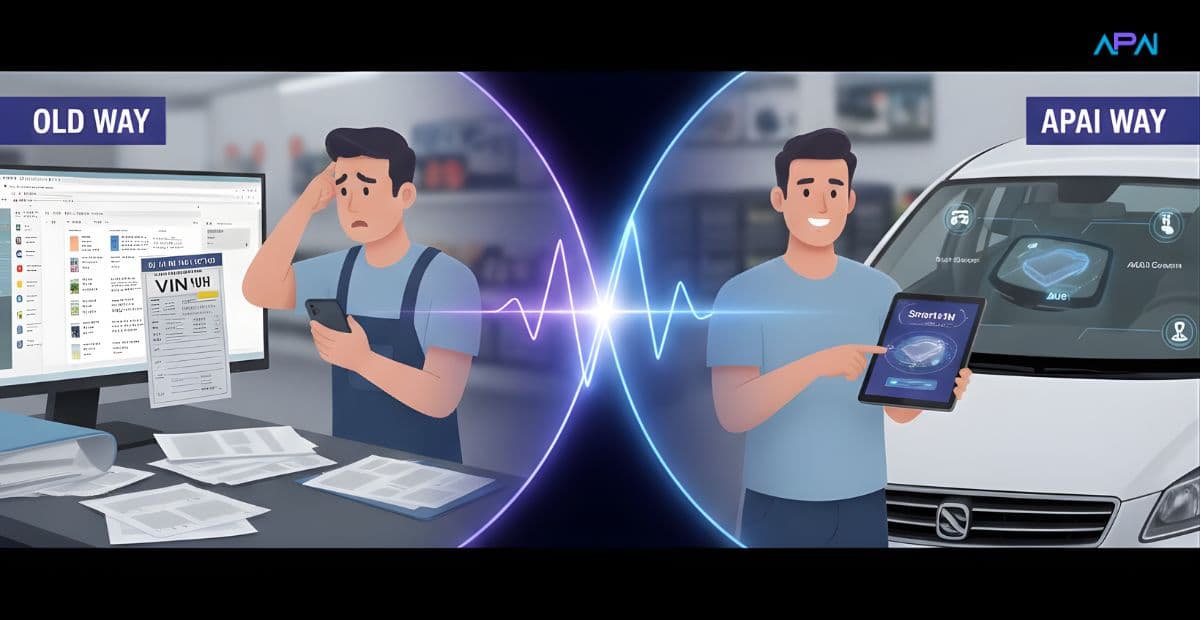
VIN Decoding for Accuracy: How Auto Glass Shops Avoid Part Errors
Discover how automated VIN decoding eliminates manual guesswork, prevents mis-ordered glass parts, and ensures correct NAGS part mapping.
Ready to Scale Your Shop?
The free APAI VIN decoder is just the beginning. Automate your quoting, eliminate part errors, and manage your technicians from one mobile-first dashboard.
No hidden fees. Build a smarter shop today.
Data sourced from the NHTSA vPIC API. Free to use · No account required.